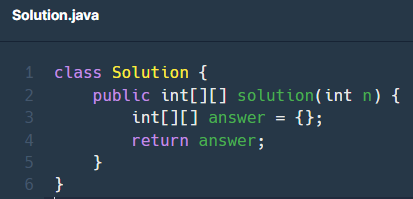
class Solution {
public int[][] solution(int n) {
List<Integer[]> answer_list = new ArrayList<>();
hanoi(answer_list, n, 1,3,2);
int[][] answer = new int[answer_list.size()][2];
for(int i=0; i<answer.length; i++) {
Integer[] now = answer_list.get(i);
answer[i][0] = now[0];
answer[i][1] = now[1];
}
return answer;
}
void hanoi(List<Integer[]> answer_list, int n, int start, int to, int via){
if(n==1) {
move(answer_list, 1, start, to);
} else {
hanoi(answer_list, n–1, start, via, to);
move(answer_list, n, start, to);
hanoi(answer_list, n–1, via, to, start);
}
}
void move(List<Integer[]> answer_list, int n, int start, int to) {
Integer[] answer = {start, to};
answer_list.add(answer);
}
}


Excellent breakdown of the Hanoi Tower problem! The recursive approach elegantly demonstrates how complex algorithms can stem from simple rules. This same logical precision applies across industries – from software architecture to strategic planning. I’ve seen similar pattern recognition thrive at Super PH where systematic approaches drive success. Your clear solution will help many developers grasp recursion fundamentals!
Become our affiliate and watch your wallet grow—apply now!
Monetize your traffic with our affiliate program—sign up now!
Опытные специалисты занимаются сбор базы для хрумера https://www.olx.ua/d/uk/obyavlenie/progon-hrumerom-dr-50-po-ahrefs-uvelichu-reyting-domena-IDXnHrG.html, чтобы обеспечить высокую эффективность работы.